 Mike Karr
Use Meta ad examples as pattern research, not as scripts to copy. The useful signal is the structure: who the ad calls out, what tension it opens, what proof it shows, and how quickly it asks for the next action.
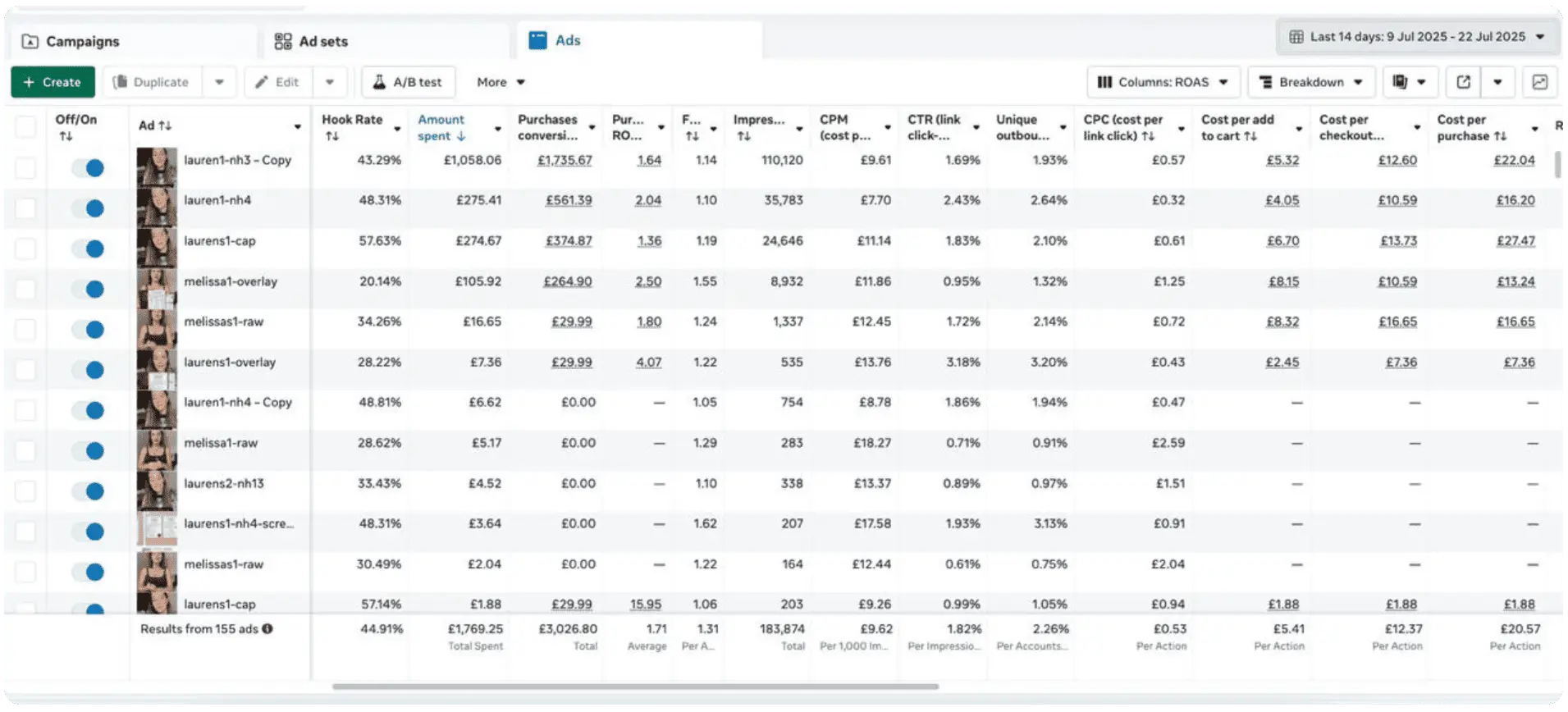
Meta ad examples worth testing
The examples below are reusable patterns for Facebook and Instagram video ads. They are intentionally written as templates so you can adapt them to your own product instead of copying a competitor's exact execution.
1. Problem callout
Hook: "If you still have to do this manually, watch this."
- Angle
- Relief from a painful workflow.
- Proof
- Screen recording, demo or before/after scene.
- Best for
- SaaS, apps, tools, operational products.
2. Before you buy
Hook: "Before you buy another [category], check this."
- Angle
- Loss avoidance and smarter comparison.
- Proof
- Side-by-side comparison or buyer checklist.
- Best for
- Competitive ecommerce categories.
3. Honest creator review
Hook: "I did not expect this to matter, but it did."
- Angle
- Creator skepticism turning into a product moment.
- Proof
- Creator uses the product on camera.
- Best for
- Beauty, wellness, home, fashion, consumer goods.
4. Proof-first demo
Hook: "The fastest way to understand it is this."
- Angle
- Evidence before explanation.
- Proof
- Visible result, screenshot, transformation or demo.
- Best for
- Products with obvious visual proof.
5. Objection reversal
Hook: "I thought this would be too expensive until I saw..."
- Angle
- Start with the objection the buyer already has.
- Proof
- Price comparison, bundle value, time saved, guarantee.
- Best for
- Premium products and skeptical buyers.
6. Routine upgrade
Hook: "This replaced the one step I kept avoiding."
- Angle
- Make the product part of a familiar daily moment.
- Proof
- Day-in-the-life scene or product-in-hand demo.
- Best for
- Consumables, beauty, home, lifestyle, apps.
How to break down a Meta ad example
When you find a promising Meta ad, do not start by rewriting the script. Start by tagging the structure.
- Hook: what happens in the first three seconds?
- Buyer: who is the ad calling out?
- Angle: what belief or pain does the ad test?
- Proof: what makes the promise believable?
- Format: creator review, demo, comparison, founder, listicle?
- CTA: what is the next action?
- Risk: what exact execution should you avoid copying?
- Remix: what can you change for your product?
Where to find current Meta ad examples
The best free source is the Meta Ad Library. Search brands in your category, then save ads that appear multiple times, use different creators, or show a repeated claim, offer or format.
Pick 10 competitors. Save 5 ads from each. Tag every ad by hook, angle, proof and format. Then build your first creative matrix from the patterns that appear most often.
Turn examples into a creative test matrix
One example should not become one copycat ad. A better workflow is example -> pattern -> angle matrix -> original hooks -> scripts -> videos.
| Example signal | What to extract | What to change |
|---|---|---|
| Creator says the problem out loud | Problem callout hook | Use your buyer's exact pain and a different creator voice |
| Product demo appears before the explanation | Proof-first structure | Use your product's strongest visible proof moment |
| Ad compares old way vs new way | Contrast angle | Compare your product against the manual habit, not the competitor directly |
| Offer is explained simply | Value clarity | Rewrite the offer for your pricing, guarantee and CTA |
FAQ
What are Meta ad examples?
Meta ad examples are Facebook and Instagram ads you study to understand hooks, angles, proof moments, formats and CTAs. The goal is to extract a pattern, not copy the ad.
Where can I see active Meta ads?
Use the Meta Ad Library to search brands and categories. For creative strategy, pay attention to repeated messages, repeated formats and ads that look like variations of the same winning idea.
How do I turn an example into my own ad?
Tag the hook, angle, proof and format. Then rewrite the hook for your product, use your own proof and create a new script with a different creator, scene and CTA.
Turn examples into videos