 Mike Karr
Most brands treat creative scaling like a production problem: make more hooks, more creators, more edits, more versions. That helps only after you know what you are actually scaling. The better question is: what part of the ad created the performance signal?
An effective video creative is a small system. It has a hook, a promise, a proof mechanism, a product moment, a rhythm, a creator type, and a conversion path. When one ad starts working, the goal is not to clone it blindly. The goal is to identify the strongest parts of that system and create controlled variations that can keep learning.
1. Define what “effective” means before you scale
A video is not a winner just because it has a strong click-through rate, a low CPA, or a few good days in the account. Those are useful signals, but they answer different questions. CTR tells you the opening and promise are interesting. Hold rate tells you the story earns attention. CVR tells you the product moment and offer are doing real work.
Before building variants, write down the job of the creative. Is it meant to introduce a new audience to the problem? Prove a claim? Convert warm traffic? Reframe price? Beat fatigue on a proven angle? Scaling gets messy when one ad is asked to solve every stage of the funnel.
2. Deconstruct the winning video into movable parts
Once you have a winner, break it into components. Do not start by rewriting the whole ad. Start with a creative teardown:
- Hook: the first claim, question, visual surprise, or relatable situation.
- Angle: the reason the customer should care now.
- Proof: demonstration, testimonial, comparison, authority, or social evidence.
- Product moment: the point where the product becomes concrete and desirable.
- Creator fit: the person, voice, style, and credibility source.
- CTA: the action that feels natural after the story.
This makes the ad scalable. Instead of producing random “new creatives,” you can decide which element stays fixed and which one changes.
3. Build a creative matrix around the strongest signal
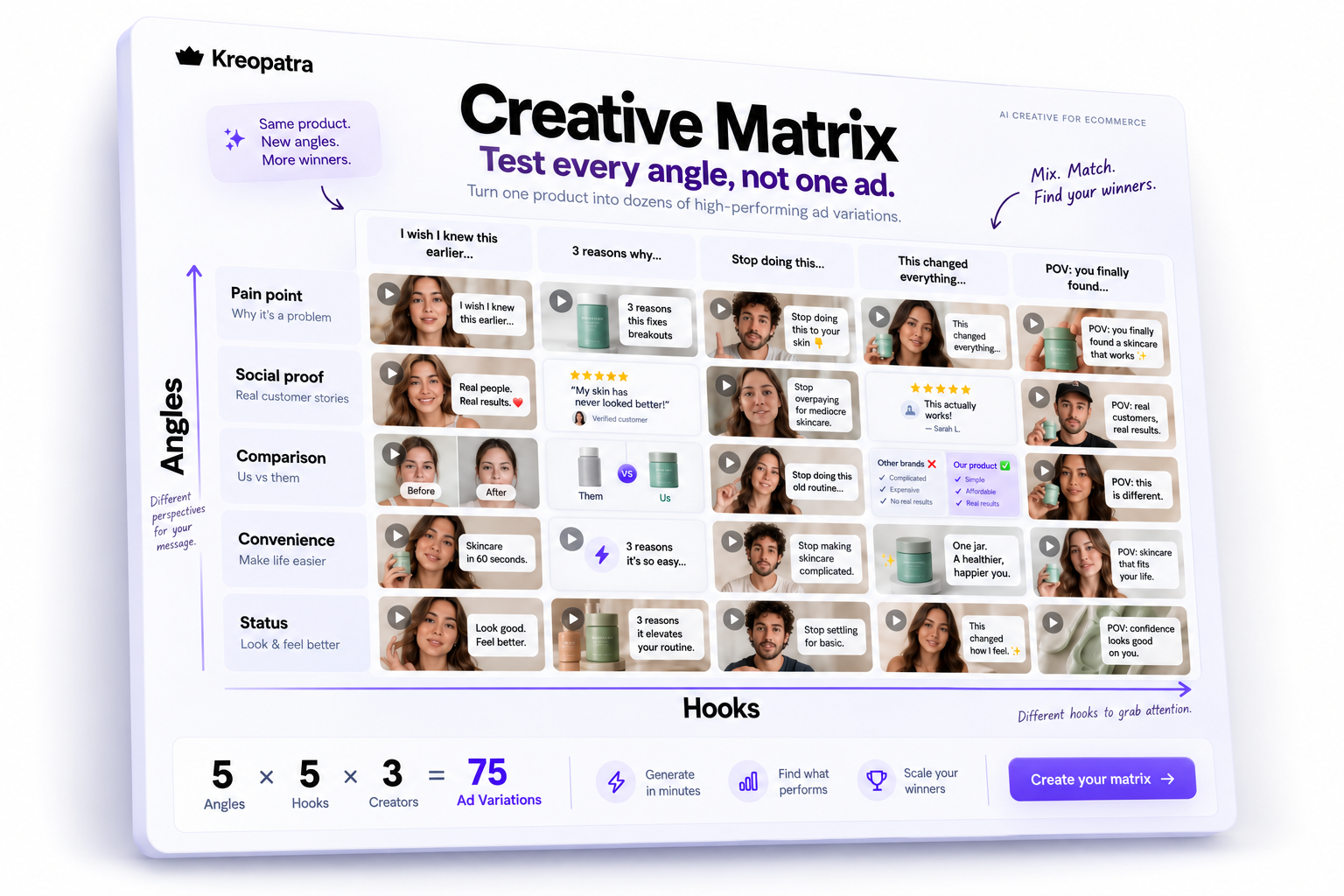
The creative matrix is the operating system for scale. Put the proven element on one axis and controlled variation on the other. If the hook is the signal, keep the hook structure and test new products, creators, or proof types. If the product demo is the signal, keep the demo and test different openings. If the creator is the signal, keep the creator style and test angles.
A useful matrix is small enough to read and large enough to learn. For example: three hooks, three proof types, and three creator styles gives you twenty-seven structured videos. That is more useful than fifty unrelated concepts because every result teaches you something about the system.
4. Separate creative thinking from production throughput
Teams get slower when every new ad needs a fresh strategy conversation. The solution is to separate the brief from the asset. Your strategist defines the matrix, your editor or AI workflow produces the variations, and your media buyer reads the results against the original hypothesis.
This is where AI creative platforms are useful: not as a replacement for taste, but as a way to remove repetitive production drag. A winning structure can become dozens of videos by swapping hooks, scenes, languages, actors, product shots, and CTAs while keeping the strategic spine intact.
Winning format
Controlled variants
Signals to read
5. Read results like a creative system, not a scoreboard
The most common scaling mistake is killing ideas too early or declaring winners too broadly. A variant can fail because the hook is weak, the creator feels wrong, the product moment arrives too late, or the ad is being shown to the wrong audience. Treat every test as a diagnosis.
After each batch, tag the result by component. Which hooks earned attention? Which proof types held it? Which creator styles converted it? The goal is not just to find one more winner. The goal is to make the next batch smarter.
Final thought
Scaling effective video creative is not about volume alone. It is about preserving what works, varying what needs learning, and building a repeatable pipeline from market signal to production to test results. When that loop is tight, creative stops being a guessing game and becomes a compounding advantage.
Build the next batch